Feeding & Watering

4 Best Wet Food Feeder for Cats 2026: Keep Meals Fresh Without Spoilage

Find a wet food feeder that actually keeps meals cool and reliable, whether for short trips or daily use.

Wet cat food doesn't keep at room temperature for long, and most automatic feeders rely on ice packs that lose their chill in a few hours, not the 48 hours some brands advertise. Buyers often discover this gap after purchase, leaving spoiled food or scrambling for backups.

The real choice comes down to capacity versus control: a larger number of compartments lets you set multiple meals for a weekend away, but the cooling method determines how long each meal stays safe. Microchip-based selective feeding solves food theft in multi-cat homes but offers no cooling at all.

This guide breaks down the trade-offs between timed ice-pack feeders and the rare actively refrigerated options, so you pick the one that fits your cat's schedule and your home's temperature.

1

Cat Mate C500 Feeder

Top Pick
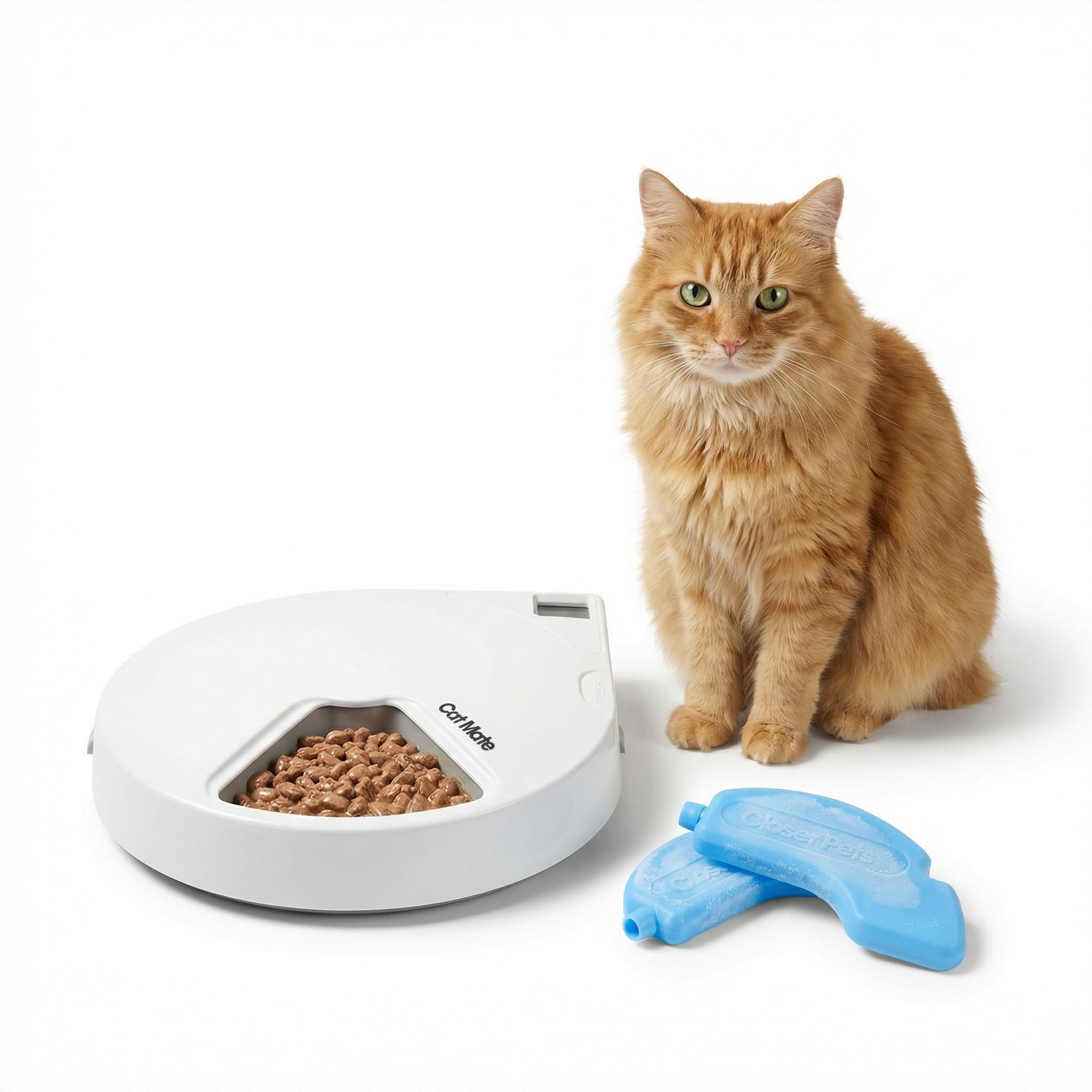
Cat Mate C500 Feeder

Short trips

Our Score 8.4/10
Check Price

Worth Noting

  • Ice packs keep food cool for only a few hours in typical room conditions, not the full interval between meals.
  • Motor mechanism can show wear after several months of daily rotation, making it better suited for occasional use.
Meals
5 compartments
Timer
Digital, 4 feeds
Cooling
2 ice packs
Cleaning
Dishwasher-safe
Read the full review

The Cat Mate C500 packs five 11.5-ounce compartments, a programmable timer for up to four feed times, and two reusable ice packs into a cost-effective package. The bowl and lid are dishwasher-safe, making cleanup noticeably quicker than most feeders in this class. For a household that needs portioned wet food across a weekend away, this setup covers the basics without requiring an app or constant monitoring.

The ice packs keep food cool for a few hours in practice rather than the full morning-to-evening span you might expect, so it works best for shorter gaps or cooler room temperatures. The rotating mechanism that advances compartments can develop issues after several months of daily use, which makes this feeder a better fit for occasional backup duty than a primary everyday solution. Owners in warm climates should keep an eye on thaw times, as performance drops when the packs melt faster.

This feeder suits owners who want a timed wet-food option for short getaways or as a supplement to manual feeding, especially if easy cleaning is a priority. If you need a machine that will run every day for years without attention, the motor durability may not meet that bar. For the price and meal count, the trade-off is clear: convenient capacity and simple care, with limitations on long-term heavy use.

Set the timer so the first meal runs shortly after the ice packs are fresh from the freezer, and the last meal hits before the packs lose their chill.

Bottom line: The C500 delivers the most wet-food capacity for the price among ice-pack feeders, provided you treat it as a trip or backup tool rather than a daily workhorse.

2

SureFeed Microchip Feeder

SureFeed Microchip Feeder

Multi-cat homes

Our Score 8.4/10
Check Price

Worth Noting

  • Lid may not close quickly enough to stop a determined food thief in some cases
  • Uses C batteries with no AC adapter option; battery life can vary significantly
Meals
1 bowl
Timer
Microchip sensor
Cooling
Cleaning
Read the full review

This feeder's microchip or RFID tag detection is the only way to keep each pet's food separate. It has no cooling, so wet food left in the bowl will spoil within hours — a critical boundary for anyone relying on it for a day's meals. The lid can also be slow to close. Best suited for multi-cat households where food theft is the primary concern, and where pets eat their portions quickly.

Position the feeder where a fast thief can't circle around, giving the lid time to close on its own.

Bottom line: If you need to stop one cat stealing another's food, this is the only feeder that does it reliably — just don't expect it to keep wet food fresh for hours.

3

PETLIBRO Wet Food Feeder

PETLIBRO Wet Food Feeder

Tech-savvy owners

Our Score 8.4/10
Check Price

Worth Noting

  • Long-term cooling performance and mechanical reliability remain uncertain because reviews are from a different product.
Meals
3 compartments
Timer
App-controlled Wi-Fi
Cooling
Active refrigeration
Cleaning
Dishwasher-safe
Read the full review

Semiconductor cooling keeps wet food fresh for up to 72 hours, and app control allows precise scheduling. However, the customer reviews are aggregated from a different product, so the actual dependability and cooling consistency are not yet confirmed by real-world usage.

Bottom line: Best for tech-savvy owners who want active cooling and are comfortable with an unverified track record.

4

Cat Mate C300 Feeder

Cat Mate C300 Feeder

Occasional use

Our Score 8.2/10
Check Price

Worth Noting

  • Cooling from the included ice pack is minimal; food temperature rises within a couple hours.
  • Motor and timer components may become unreliable after several months of daily use.
Meals
3 compartments
Timer
Digital, 2 feeds
Cooling
1 ice pack
Cleaning
Dishwasher-safe
Read the full review

With three compartments, a digital timer, and a budget-friendly price, the Cat Mate C300 is a compact solution for short trips. Its dishwasher-safe components make cleanup after wet food easy. Motor and timer issues can arise with heavy use, and the ice pack provides only brief cooling. This feeder suits owners who need a simple timer for weekend use or as a backup, not for daily feeding.

Pre-freeze the ice pack for at least 24 hours for maximum cooling duration.

Bottom line: A budget-friendly option for short absences, the C300 works well as a backup but is not built for daily wet food feeding.

How to Choose

Number of Meals

The number of compartments determines how many feedings you can pre-load. A 5-meal feeder covers a full day for most cats, while a 3-meal unit works for a single morning-to-evening gap. More compartments mean a larger footprint and more surface area for ice packs to cover, reducing per-meal cooling efficiency.

If you need to cover a weekend, choose at least 5 meals with ice packs. For daily use, a 3-meal feeder with a single ice pack may suffice, but you will need to refresh the pack every 8-12 hours.

Cooling Capability

Passive ice packs are the norm, but their advertised duration of 48 hours is unrealistic in warm homes. Real-world performance is 6-10 hours before food reaches room temperature. Active refrigeration (semiconductor cooling) keeps food cold for up to 72 hours, but only one product on the market offers it and its reliability is unverified due to review aggregation issues.

For anything beyond an overnight absence, you need either active cooling or a feeder that seals tightly to slow spoilage. Ice packs work best when pre-frozen and placed directly under the bowl, not on top.

Timer Reliability

Digital timers are more precise than mechanical ones but still susceptible to battery drain and encoder jams. Many rotating feeders rely on a simple motor that turns a wheel; if the timer drifts or the mechanism sticks, a meal can be skipped or delayed.

Microchip-based feeders eliminate timing issues by responding only to the cat's tag, but they require batteries and have no scheduled dispensing. For a timed routine, look for models with separate clock circuits and a low-battery warning.

Durability of Rotating Mechanism

Rotating feeders with a central motor and gear train are the most common failure point. Gears can strip, motors can stall, and the lid can jam if food residue builds up. This is especially problematic for daily use versus occasional weekend trips.

If you plan to use the feeder every day, prioritize models with metal gears or direct-drive mechanisms. For backup or travel use, the plastic gear trains in affordable feeders may last long enough.

Ease of Cleaning

Wet food residue accelerates gear wear and attracts bacteria. Dishwasher-safe bowls and lids reduce cleaning effort, but the main unit itself rarely is. Models with removable trays and sealed motor housings are easier to wipe down.

A feeder that takes apart completely for cleaning will last longer because food particles won't accumulate in crevices. Avoid feeders with non-removable partitions that trap moisture.

Frequently Asked Questions