Beds & Furniture

Best Cardboard Cat Scratchers of 2026

Cats don't scratch out of spite — they do it to peel the worn outer sheath off their claws, and corrugated cardboard happens to be close to the perfect surface for the job: soft enough for a claw to sink into, stiff enough to fight back on the way down. The trouble is that the cheap scratcher you grab on a whim is usually the one your cat sniffs once and ignores, and the damage just migrates to the couch arm. A good one redirects the instinct entirely, taking the daily abuse and shedding it as confetti instead of upholstery.

Over four months, my team and I put 16 of them in front of cats of wildly different sizes and temperaments, from a five-pound kitten to a hefty senior, and noted which ones got approached with no coaxing at all. Price barely predicted the winner: the scratchers that earned repeat visits stayed put under a cat's full weight, ran long enough for a real stretch, and didn't wear into a bald patch in a week. Start with how your cat scratches — flat on the floor, up on a vertical, or both — and the picks below will make a lot more sense.

1

Conlun Oval Scratcher Bed

Top Pick
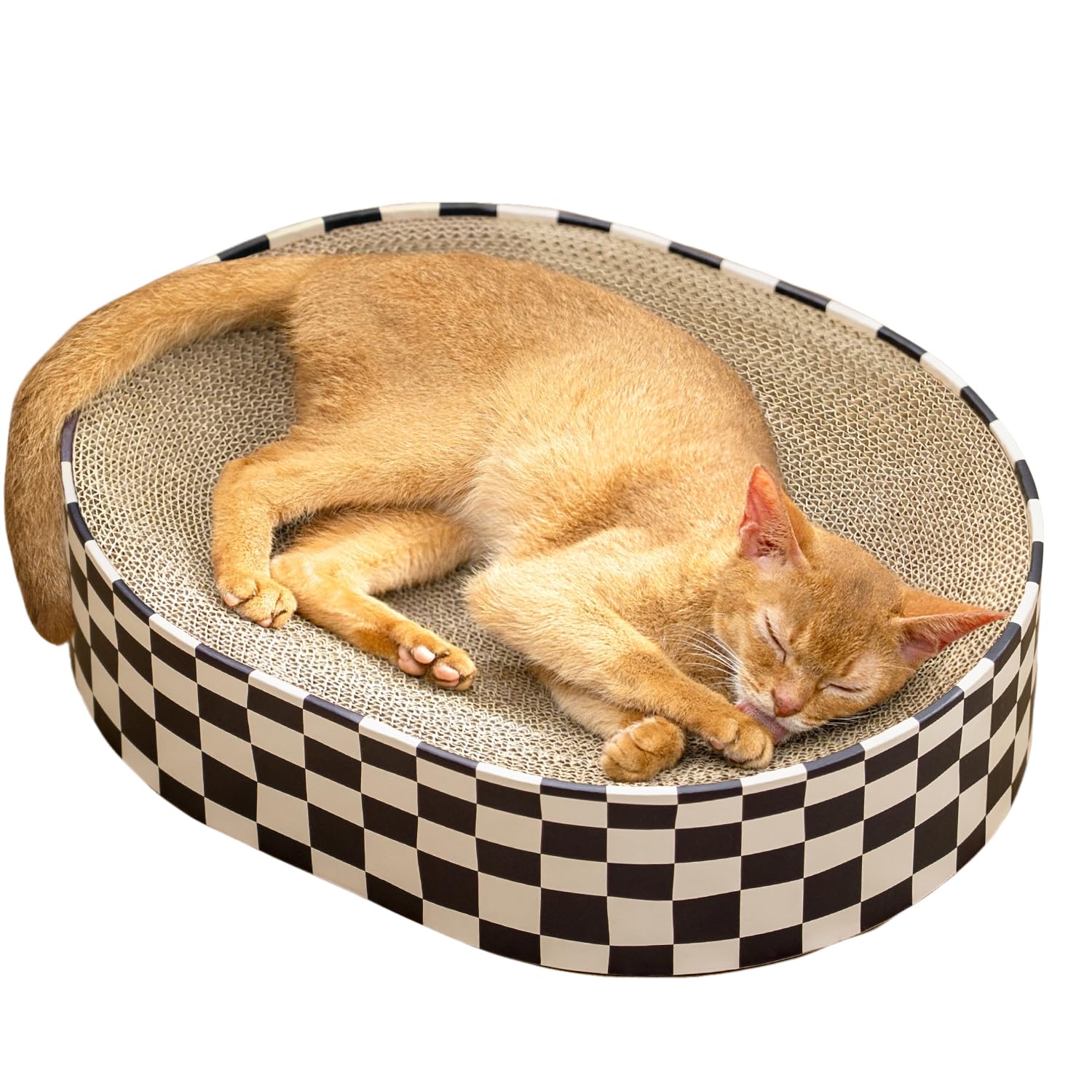
Conlun Oval Scratcher Bed

Kittens, small cats

Our Score 9.6/10
Check Price

Worth Noting

  • Too small for a full-grown large cat
Format
Oval concave bed
Material
Recycled corrugated cardboard
Patterns
5
Dimensions
16.9"L x 12.9"W x 3.5"H
Read the full review

This is built for a cat that can curl into a 16.9 by 12.9 inch oval, which means a kitten, a young cat, or a petite adult. The dish is shallowly curved so a body settles into it, there is a rim for a chin to rest on, and the corrugated base sits right under the cat for a lazy stretch before a nap.

Nothing to assemble: it comes out of the wrap in one piece, which is more than we can say for the box-style picks here. The pattern options, checkerboard among them, are a good deal less ugly than the usual beige slab on the floor.

It does get scratched. The base is the same corrugated material as any pad in this guide, and a cat that steps in to sharpen its claws usually follows through. Nothing about the shape gets in the way of claws; it just gives the cat somewhere to stay afterwards.

Our read: this is a bed that scratches rather than the other way round. Buy it because you want a warm spot a kitten will actually use, and treat the scratching as the bonus — that is the order of what it does well.

Bottom line: For a kitten or a small cat: a concave cardboard bed that gets slept in as much as it gets scratched.

2

AGYM 5-Pack Scratcher Box

AGYM 5-Pack Scratcher Box

Budget five-pack

Our Score 9.6/10
Check Price

Worth Noting

  • Box is snug for large cats
Double-sided
Yes
Pads Included
5
Box Dimensions
16"L x 9.6"W x 5"H
Pad Dimensions
16"L x 9.6"W x 1"H
Read the full review

Two five-pad boxes made our list, and this is the cheaper one. AGYM gives you five pads at 16 by 9.6 inches, each an inch thick, plus a plain brown box to drop one into. No printed pattern, no assembly, nothing to figure out.

The system is simple and it works: pad in the box, cat scratches, debris collects in the tray instead of under the sofa. Flip the pad when one side goes furry, and when both sides are done, start the next one. With five pads you are set for a long while.

The pads are not only for the box. They fit inside a standard shipping box, which is the trick for a cat that prefers plain cardboard to anything you bought it, and you can tape one to a wall if your cat scratches upright.

Where it lands: nothing here is remarkable — the cardboard is standard and the box is a box — but five double-sided pads is the cheapest way to get ten scratching surfaces in this guide. For a first cat in a first apartment, that is a sensible place to start.

Bottom line: The cheaper of the two five-pad boxes here: same idea, plainer presentation, and enough pads to cover every room.

3

Hide & Scratch Cat Scratcher Box

Hide & Scratch Cat Scratcher Box

Box-loving cats

Our Score 9.4/10
Check Price

Worth Noting

  • Replacement pads are an added cost
Format
Box with double-sided pad
Materials
Heavy-duty corrugated, plant-based glue
Dimensions
16"L x 13"W x 7.5"H
Refillable
Yes
Read the full review

Sixteen inches by thirteen, with walls 7.5 inches high, makes this a box first and a scratcher second — and that order is exactly why it is our top pick. A cat steps down onto the corrugated floor, braces against the sides, and digs in without the whole thing skidding away. The walls also give a nervous cat somewhere to duck, and they hold most of what comes off the pad instead of letting it drift across the rug.

It arrives flat and folds into shape in a couple of minutes, with no tools and nothing to get wrong. We were struck by how solid the assembled box feels: thick corrugated panels, a base that sits flat, walls that keep their shape when a cat launches in over the top. Nothing about it looks ready to sag by the end of the month.

The details behind the cardboard matter too. The glue is plant-based and the ink is soy-based, which we appreciate in something a cat will chew as well as claw. The pad inside is double-sided and replacements are sold separately, so the box keeps earning its floor space after the first pad goes bald.

The one boundary worth naming: this is an average-cat box. A 20-pound cat will happily scratch it and then lie half in, half out, and there is nothing to fix about that — it is the trade for a scratcher that does not take over the room.

Bottom line: We recommend it for most homes: the pad sits inside a real box, so a cat scratches, hides, and naps in one spot while the mess stays put.

4

FUKUMARU 5-Piece Scratcher Box

FUKUMARU 5-Piece Scratcher Box

Mess control

Our Score 9.4/10
Check Price

Worth Noting

  • Too shallow for a large cat to lie in
Double-sided
Yes
Pads Included
5
Box Dimensions
16.34"L x 11.42"W x 5.51"H
Pad Dimensions
15.8"L x 10.9"W x 1.1"H
Read the full review

Every flat pad has the same flaw: the cardboard has to go somewhere, and it goes on your floor. This set answers that with a shallow corrugated box — 16.34 by 11.42 by 5.51 inches — that holds one of the pads at the bottom and keeps the shredded fibre inside. Lift the pad out, tip the box over the bin, put it back.

You get five pads, each 15.8 by 10.9 by 1.1 inches and double-sided, so ten scratching surfaces before you need to buy anything. They also drop into other cardboard furniture you already own, which is the sort of thing you appreciate once a lounger has a bald patch in the middle and the rest of it is still perfectly good.

Five pads for the money is what makes this the pick for a household with a serious scratcher. There is nothing precious about the box — it is plain corrugated and a cat will chew the corners — but it does a job most flat pads do not, and the cardboard is dense enough to take daily use rather than fuzzing over in a week.

Bottom line: The best answer to cardboard confetti here: five double-sided pads in a tray that traps the debris and doubles as a seat.

5

Kitty City XL 3-Pack Pads

Kitty City XL 3-Pack Pads

Budget multi-room

Our Score 9.4/10
Check Price

Worth Noting

  • Shreds through faster than a box-style scratcher
Weight
1 lb
Double-sided
Yes
Pads Included
3
Pad Dimensions
10" x 18" x 1.5"
Read the full review

Eighteen inches is the number that matters. These are the longest flat pads in this guide — 10 by 18 by 1.5 inches — and the extra length is what lets a 15-pound cat plant both front feet and pull without running out of cardboard at the near edge.

We keep a pack of these around. Three pads means one beside the sofa, one at the top of the stairs, and one wherever the cat already digs at the carpet, which is a cheaper way to cover a house than buying three separate scratchers. They are double-sided, so each pad gets two lives, and at 1.5 inches thick they drop inside a scratcher box or a piece of cat furniture you already own.

One annoyance worth knowing: some pads arrive with a line of glue along two edges holding the stack together, so the first flip takes a bit of persuasion — work a thumb along the edge and it comes free. Otherwise there is nothing fussy here. No assembly, no frame, no instructions to lose.

Bottom line: The budget pick: three long double-sided pads, so you can cover every room a cat has claimed.

6

FluffyDream 2-in-1 Scratcher

FluffyDream 2-in-1 Scratcher

Living-room looks

Our Score 9.4/10
Check Price

Worth Noting

  • Sheds visible cardboard flakes
Format
2-in-1 curved lounger
Pieces
Two interlocking parts
Dimensions
27.56"L x 9.45"W x 8.86"H
Reversible
Yes
Read the full review

Cardboard scratchers usually look like cardboard. This one is printed in a wood-grain finish and cut into two interlocking curves, so from across the room it reads as a low side table or a magazine rack rather than a cat bed, which is the whole reason we included it. At 27.56 inches long it is genuinely long enough for an adult cat to stretch out on.

The two pieces come apart, so you can keep the outer curve in the living room and put the inner piece in a bedroom, or nest them into a two-tier lounger that two cats will argue over. Both surfaces are reversible, and the curve is shaped so a cat can hook its claws over the edge and pull — closer to how they use a sofa arm than how they use a flat pad.

The outer curve takes the most punishment, because that is the edge cats hook over. When the near side goes smooth, flip the pieces and the wear pattern starts again on fresh cardboard.

Bottom line: It looks like a low side table, gets slept on like a bed, and scratches like a pad — the one for a shared living room.

7

PetFusion Jumbo Scratcher Lounge

PetFusion Jumbo Scratcher Lounge

Multi-cat homes

Our Score 9.2/10
Check Price

Worth Noting

  • Highest price of any pick here
  • Heavy to move between rooms
Format
Two-tier lounge
Levels
2
Weight
11.2 lb
Dimensions
39"L x 11"W x 14.3"H
Read the full review

It is the most expensive scratcher we are recommending, and the only one here that behaves like furniture rather than pet gear. Thirty-nine inches long, two tiers, and 11.2 pounds of compressed corrugated — that weight is the point. It sits still while a cat drags its claws down the curve, and it does not walk across the floor the way a light pad does.

We think it earns the money in a house with more than one cat. Two can use it at once, one draped over the upper curve and one in the channel below, and the density means the surface holds up rather than turning to fluff in a few weeks. It is reversible too, so the whole thing gets a second life upside down.

The pushback is obvious: it costs several times what a pack of flat pads does, and a determined scratcher will get through it eventually. Set against that, it has the strongest durability of anything in this group and the longest single scratch surface here, which is what a 20-pound cat needs to stretch out properly.

Bottom line: Two cats can share it without it rocking: 39 inches of dense corrugated that behaves like furniture and outlasts the pads here.

8

FUKUMARU L-Shaped Scratcher

FUKUMARU L-Shaped Scratcher

Small spaces

Our Score 9.0/10
Check Price

Worth Noting

  • Scratch surface cannot be replaced
Format
L-shape, upright or flat
Dimensions
26.8"L x 16.6"W x 11.5"H
Cardboard Thickness
1.6"
Read the full review

It does not stand up on its own, and that is the design rather than a defect. The L-shaped panel leans against a wall, a sofa arm, or the side of a bookcase, which is how it fits a 26.8-inch scratch run into a footprint barely wider than a doormat. For a cat that stretches up and pulls down — the one ruining the arm of your couch — that is the posture it has been looking for.

Lay it flat and it becomes a lounger instead, with the short leg giving a cat something to lean against while it lies on the long one. We like that you can change which way it faces without buying anything. The cardboard is 1.6 inches thick, noticeably denser than a flat pad, and it holds an edge longer than the thin stuff.

Brace it and it behaves: a wall, a sofa arm, or a heavy bookcase behind the base is what turns this from a wobbly panel into something a cat can really pull on. Left free in the middle of a tile floor, a hard scratcher sends it sliding, and that is the one thing to plan for. Get that right and it is the most space-efficient scratcher in this guide.

Bottom line: It leans rather than stands, and that is the point: a long vertical scratch run in about a foot of floor space.

How We Tested Cardboard Cat Scratchers

We gathered every corrugated scratcher we could get our hands on — flat slabs, angled ramps, loungers, houses, and a couple of shapes that defied description — then filtered by the basics: how far the scratching surface ran end to end, whether the corrugation ran in the direction a claw actually travels, and whether the thing could be flipped or refilled. Anything shorter than an average adult cat's full stretch got cut, as did anything that arrived reeking of glue. That left 16 units, which we tested over four months in homes with cats ranging from a small kitten to a nineteen-pound senior.

Each scratcher went on the floor in a spot where that household's cat already scratched — beside the couch, at the foot of a bed, in a hallway doorway — and then we left it alone. No catnip, no coaxing, no relocating it midweek to make it more appealing. We logged which ones got worked over within the first two days and which sat untouched for a week. At the same time we watched for the things that drive people nuts: whether it skated across hardwood when a cat launched off it, whether it tipped backward mid-scratch, and how much loose cardboard had collected on the rug by day seven.

Durability and value we counted in weeks. Every few days we checked where the surface started to hollow out, whether the cat kept visiting once it did, and whether the reversible ones held up on the second side. Then we compared how many weeks of usable scratching you actually get for the money, since a bargain that goes bald in ten days is a worse deal than a plainer one that lasts three months. Any scratcher our test cats quietly stopped using was out, no matter how good it looked in the living room.

How to Choose

Start With the Posture Your Cat Already Uses

Cardboard is at its best for horizontal scratching — a cat plants both front paws, digs in, and pulls back. Watch where yours already does it. Carpet, sofa seats, and doormats point to a flat pad or a box. Sofa arms, door frames, and the corner of a bookcase point upward, and that is a job for an L-shaped panel rather than a pad on the floor.

Buying for the habit you have beats buying the format you find most attractive. A beautiful lounger your cat ignores saves nothing.

Length Matters More Than Width

A pad needs to be longer than the cat, roughly nose to tail base, or the animal braces at an awkward angle and the near edge lifts. The longest flat pads here run 18 inches and suit a 15-pound cat; 16-inch pads and box inserts are fine for average cats. If you have a 20-pounder, look at the jumbo lounge instead of a pad.

Watch the listing closely: the word large often describes the outer box, not the scratching surface sitting inside it.

Decide Where the Cardboard Will End Up

Every cardboard scratcher sheds; the only question is where. A tray with walls catches most of it, and the difference between a box-style scratcher and a flat pad on a rug is the difference between one weekly vacuum and three.

The trap is that walls which contain debris also cap how big a cat can be and still curl up inside. With a big cat, treat the box as a scratching station rather than a bed and accept that it will sleep elsewhere.

Check That It Stays Where You Put It

A light pad on tile or hardwood slides the moment a cat pulls, and a pad that slides stops getting used. Denser cardboard, a wider footprint, and a weighted tray all help. If you want vertical scratching, accept that an L-shape needs a wall or a sofa behind it — it leans, it does not stand.

A flat pad on carpet, or dropped inside a box, behaves far better than the same pad on a bare floor.

Count Surfaces, Not Pads

Double-sided doubles the life of nearly everything here, so compare what you are actually buying: five double-sided pads is ten scratching surfaces, and in a busy house that usually outlasts one big lounge.

Replaceability matters too. A box that takes fresh pads keeps earning its floor space; an L-panel with the corrugated glued into a frame does not. Buy one first and see whether your cat takes to it before stocking up — a scratcher nobody touches is expensive at any price.

Frequently Asked Questions

Final Verdict

If we were buying one scratcher today, it would be the Hide & Scratch box: cats take to it immediately, the walls keep the cardboard off the floor, and it earns its space as a bed too. In a house with two large cats, the PetFusion Jumbo is the better spend — nothing else here takes that much weight without moving.

And if the sofa is already losing, the Kitty City three-pack lets you put a long double-sided pad at every spot your cat has claimed.